
7 Charts: Value Is Flowing Up The Stack.


BIG PICTURE
💡 AI value creation is starting to flow up the stack.
It's moving from the infrastructure layer, the semis, the data centers, the networking buildout, into the software and application layer. Two companies reported earnings this week, UiPath and Okta, and we think both are early indications of that transition.
Here's the way we think about it. Both of these companies are big beneficiaries of what's to come in AI, specifically around identity and access management and workflow orchestration. Every agent out there is going to require access to the tools that enterprises already use. Those enterprises are going to partner with organizations that help them orchestrate and govern the AI that's happening inside the organization. That's exactly where Okta and UiPath sit in the stack.
An important distinction we've been thinking about. Today's AI models are probabilistic. They create probabilities on what's next. Deterministic workflows are not AI at all. They're process automation. The combination is powerful. When you route tasks through deterministic logic, you increase the success rate of those tasks and you reduce compute and token usage because outcomes aren't dependent on probabilities running in a loop. They run through a logic tree. That's the unlock. Okta governs who and what can access the enterprise. UiPath provides the orchestration layer that routes the work. We think this is one of the more interesting setups in software right now. Let's get into it.
[ 1 ] The mobile internet playbook says software is next.

A16Z put out a great chart that maps the history of value creation during a major technology transformation, specifically the mobile internet cycle from 2010 to 2016. The pattern was semis first, then infrastructure and devices, then software.
By the end of that cycle, software had outperformed semis by roughly 1.85x to 1.00x. We think this chart is the right structural lens for what's happening in AI right now.
The infrastructure buildout, semiconductors, data centers, power, networking, has been the dominant story for the last two years. The software layer is starting to catch up. You can see that on the next few charts.
[ 2 ] Okta crosses $1.9B ARR. NRR ticks higher for the first time in 11 quarters.


Okta reported Q1 FY27 results after the close yesterday. This is a new position for us over the last two months.
Subscription revenue came in at $750M, up +11.3% Y/Y. That's twelve quarters of grinding growth with Y/Y holding in the low double digits. ARR also crossed $1.9B, up +12.3% Y/Y.
Okta customers with annual contract value above $100K now sit at 5,180. The number we were really watching was net revenue retention, which ticked back to 107%. That's the first uptick in 11 consecutive quarters. To us that's the tell as it relates to AI.
Identity and access management is the gating layer for every agent that runs inside an enterprise. You don't let an agent touch your systems without knowing who or what it is and what it's authorized to do.
They also launched Auth0 for AI Agents and Okta for AI Agents this quarter. Two SKU families, one identity fabric. Builders and IT now both have an Okta-native path. Still early days on this, but the net revenue retention inflection paired with the new agent SKUs is worth watching closely.
[ 3 ] UiPath ARR also crosses $1.9B. Deterministic plus probabilistic is the combination.

UiPath ARR crossed $1.9B this quarter as well, hitting $1,901M and growing +12.3% Y/Y. That's almost exactly the same scale as Okta.
The reason deterministic automation and probabilistic AI are a powerful combination is straightforward. When you route a task through logic trees instead of asking a model to re-infer the answer every time, you get higher task completion rates and you use fewer tokens. The model handles the ambiguous judgment calls. The automation handles the repeatable steps.
UiPath is the layer that orchestrates that routing inside the enterprise. They've been building this out for years and the AI cycle is now the tailwind. Something we've been explicit about in terms of our thesis.
[ 4 ] Stripe Atlas is incorporating a company every 12 minutes.

Stripe Atlas is now incorporating a company every 12 minutes. Think about that. In 2017 that number was 295 minutes per company, so we've seen a 25x compression in the time it takes to spin up a new legal entity over the last nine years.
We think this is another indication of how infrastructure is enabling a new wave of software creation. As new businesses form faster, they immediately start requiring software to run those businesses. Data management, identity, orchestration, productivity. Value starts to accrue to the software application layer the moment those companies are alive.
[ 5 ] The S&P 500 is at all-time highs. Consumer sentiment is at a 48-year low.

The S&P 500 is near an all-time high while the final University of Michigan Consumer Sentiment reading for May came in at 44.8. That's the widest divergence between equity prices and consumer confidence in 48 years of data.
This is exactly the deviation you're also seeing inside the market, where consumer-related names aren't participating as aggressively and software names are in a similar position. We think both will come to fruition. Businesses are doing fine. The macro economy is doing fine. Valuations are very cheap in some of those areas.
[ 6 ] Used car prices are up +7.52% in 90 days. Tesla is up +14.83%.
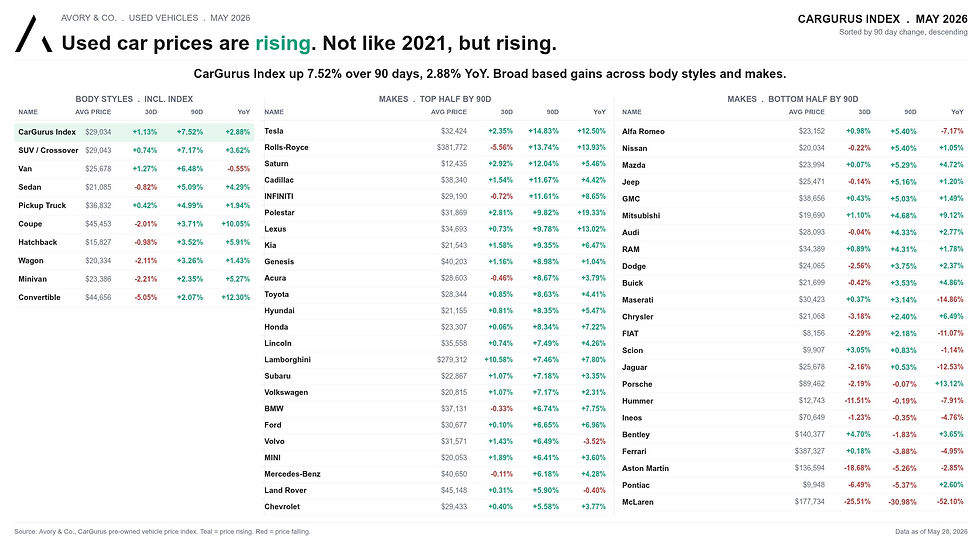
This one is interesting. CarGurus Used Vehicle Price Index is up +7.52% over the last 90 days, with the average used car now at $29,034 and Y/Y growth at +2.88%. Tesla is leading the move at +14.83% in 90 days and +12.5% Y/Y. The move is broad-based across body styles and makes, which is what makes this an important indicator rather than an anomaly.
As you know we are tracking real-time data on used vehicles closely as it relates to inflation. This isn't 2021. We're not seeing demand completely overwhelm supply. But rising used car prices feed into the services inflation print, and that's a data point we're watching closely.
[ 7 ] Hedge fund shorts are at a fresh 10-year high.

This data point has been floating around. Goldman Sachs Prime data shows hedge fund short exposure at 12.8% of US gross, a fresh 10-year high that has now passed the 2021 peak.
Historically that doesn't specifically lead to tops in markets. There are certain instances where it does, but as a rule it's not a reliable sell signal.
What it is an indication of is how markets can be at all-time highs while professional capital is positioned for the opposite. Generally if you go back multiple decades you see the reverse configuration at market tops. We've been saying for quite some time here at Avory that the defensive positioning across institutional capital is a feature for patient long-side investors, not a warning. This data point reinforces that read.
Net Net
Value is starting to flow up the stack. Okta and UiPath both crossed $1.9B in ARR with growth holding in the low double digits, and Okta's net revenue retention ticked higher for the first time in 11 quarters. The mobile internet playbook from 2010 to 2016 is the right structural lens. Semis first, then infrastructure, then software, and we're early in that third leg. Meanwhile the S&P is at all-time highs, consumer sentiment is at a 48-year low, hedge fund shorts are at a fresh 10-year high, and used car prices are rising but nothing like 2021. Professional capital is defensive, sentiment is washed out, the consumer is steady, and the fundamentals are doing fine. That's the setup patient capital tends to get rewarded in, and our conviction hasn't changed.
Looking Ahead
NFP (June 5). Initial claims are at 209K and the ADP pulse held at 35,750 jobs per week through early May. The payrolls print will tell us whether the labor market is holding its footing or starting to slow. We want a number that keeps the Fed patient without reopening the wage conversation.
US-Iran deal progress. The Strait of Hormuz remains closed. Rubio's comments this week suggest a proposal is on the table, but oil futures are the real-time read. We're watching the front-month every day.
Software earnings follow-through. Okta and UiPath set the frame this week. The question heading into June is whether the rest of the enterprise software layer starts to show the same NRR inflection. That's the signal we're watching for the AI value-up-the-stack thesis.
That's all for this week.
Know another investor who'd find this useful? Forward it along or share on your page.
About Avory & Co.
Investing Forward.
Avory specializes in high-conviction equity strategies, emphasizing Secular Growth and Transformation Stories driven by exceptional teams. Data guides decisions. We cater to high net worth investors, family offices, and institutional investors. Note: This information doesn't constitute a recommendation to buy or sell any mentioned securities. Avory is based in Miami, Florida with clients all across the globe.
Speak to us:
Send us an email: Team@avoryco.com
Want to invest? We are on most platforms.
Want More
Avory YouTube: Channel
Avory Podcast: Podcast
Disclaimer: Not a recommendation to purchase or sell any securities mentioned. This is for educational purposes only.


Comments