
Oil, Vix Spikes, What do they Mean?


Happy Friday. There is a lot going on right now. Earnings, war headlines, AI developments, and plenty of macro noise. Adding to that, we got a chance this week to hang out with some of the companies that came down to Miami for Future Proof conference.
On the week I wanted to step back and simply share some of the data we have been looking at. The reason is that historically, even during periods of oil spikes and geopolitical conflict, markets have generally been able to absorb the noise. The key variable tends to be the economic backdrop. The bigger issue is whether the economy was already heading toward a recession. When that is the case, returns tend to suffer. When it is not, markets typically look through the shock.
Right now we see a reasonable case that the economy remains resilient. Oil spikes historically tend to be short lived, and that pattern is even more common during midterm election years. At the same time, tax refund data shows we are running roughly 10% higher in dollar terms even though fewer returns have been filed so far. That suggests more refunds are still on the way.
More refunds mean more liquidity flowing back to households, which can help offset some of the pressure from higher oil and gasoline prices.
On the corporate side, AI continues to move incredibly fast. We use it heavily ourselves. But despite all the noise around AI disruption, we continue to see companies executing well, especially in software and software-adjacent businesses. So while the headlines feel intense, the underlying data still points to an economy and corporate sector that remain fairly resilient.
Here is the summary if you want just that:
Oil spike, what does it mean for markets?
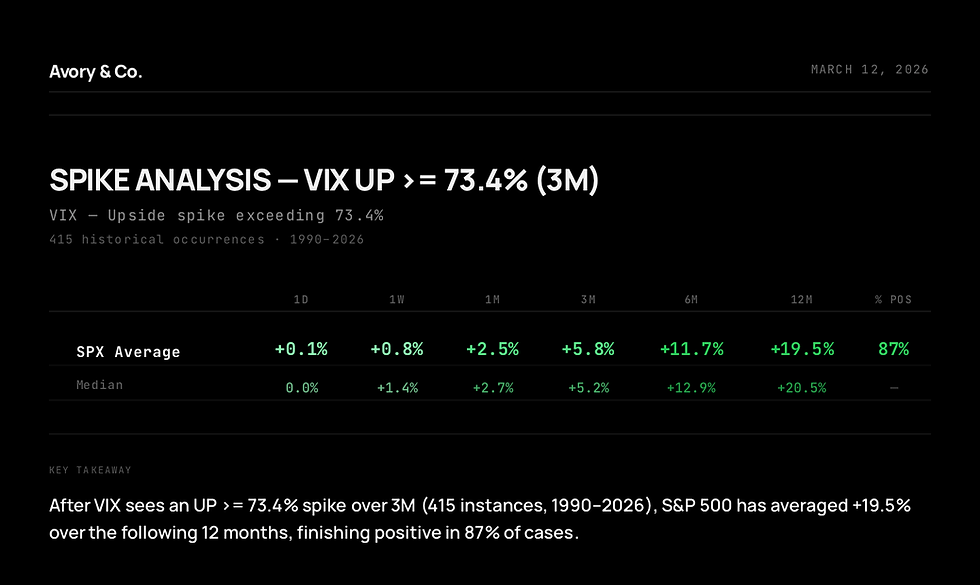
Vix spike, what’s it mean?
Insiders buying back shares in financial sector
+10% growth in tax refunds…
As we always suggest, markets rarely move in straight lines. That’s a basic reality of investing. Yet every so often you see stretches of momentum that signal something changing beneath the surface.
Recently the IGV software index posted a 10-day streak of open to close gains, if you follow us consistently then you know it is something we had flagged as a possibility as bottoming signals were starting to emerge in the sector.
What is key is that when IGV experiences these kinds of win streaks, the forward returns tend to skew positive, with median performance improving meaningfully over the following months and even into the next year. That’s our base case
This week’s Iran headlines added another layer of sentiment fear across markets, which can create short-term volatility, but it does not necessarily change the underlying setup.
Over that time frame software has been up 24% 12 months later with 100% positivity for software and the market.

To add to that software comment. We continue to see tech related job openings perk up.

Now people are clearly concerned about oil. And that concern is understandable. So we went ahead and broke down the data to see whether the worry actually makes sense.
Two things stood out.
First, the share of consumer spending going toward gasoline has steadily declined. Today it is roughly 50% less significant than it was in the 1980s.

Now spikes can feel nerve-racking. But when we broke down the data, a spike like the one we’ve seen over the last three months, with oil up roughly 68%, has not historically had a meaningful negative impact on stocks.
If anything, the opposite tends to happen.
Following similar oil spikes, the S&P 500 has often gone on to post strong returns. +33% on average 12 months later.

Then we asked another question. What happens when oil is above $100?
Brent is currently above that level, though WTI is still below it. Looking at history, forward market returns in these environments have generally not been bad. The median return for the market is about +9.4%.
The key caveat is the economic backdrop. When oil is above $100 and the economy is moving toward a recession, returns tend to be much weaker. In those cases the setup skews negatively.
So it really comes down to your base case.
If you believe a recession is coming, the risk profile is less attractive.
If you do not see a recession on the horizon, the market has historically been able to look through the noise.
We remain in camp #2.

Why camp #2.
First, we shared how gas has become less of a factor.
Second, midterms likely incentive the admin to get prices and wars away from the story.
Third, we are seeing +10% growth in refund amounts and still have more refund checks.
That matters because tax refunds act as a seasonal liquidity injection for consumers. Larger refunds can translate into stronger short-term spending across discretionary categories.

Now markets have been skiddish. Are we peaking here in fear? Hard to tell but the 73% spike in VIX is usually met with healthy returns on the other side. Markets are up median 28% 12 months later with 87% positive outcomes.
So obviously we remain at the forefront of what is happening globally and ensuring our companies are doing their part.
One last datapoint worth noting is that we are seeing corporate insiders at financial firms increase their buying quite dramatically. Historically, this has been a bullish signal.
Financial companies sit at the heart of the economy. They see credit demand, deposit flows, capital markets activity, and business conditions in real time. When insiders at these firms begin buying their own stock, it often reflects confidence in the underlying economic backdrop.
So when insider activity in financials starts to rise, it is typically viewed as a very constructive signal for the broader economy and markets.

We will keep you updated. Go check out our videos on Youtube, where we go deep into these topics.
About Avory & Co.
Investing where the world is headed.
Avory specializes in high-conviction equity strategies, emphasizing Secular Growth and Transformation Stories driven by exceptional teams. Data guides decisions. We cater to high net worth investors, family offices, and institutional investors. Note: This information doesn't constitute a recommendation to buy or sell any mentioned securities. Avory is based in Miami, Florida with clients all across the globe.
Speak to us: Schedule a Brief Zoom Meeting
Send us an email: Team@avoryco.com
Want to invest? We are on most platforms.
Want More
🎥 Avory YouTube Channel
🎙️ Avory Podcast
Disclaimer: Not a recommendation to purchase or sell any securities mentioned. This is for educational purposes only.


Comments